
Let's Get Physical
Character Physicality in Screenwriting

Next week, I’ll be talking to my students about character physicality as inspired by watching dance. Huh? Let me explain…
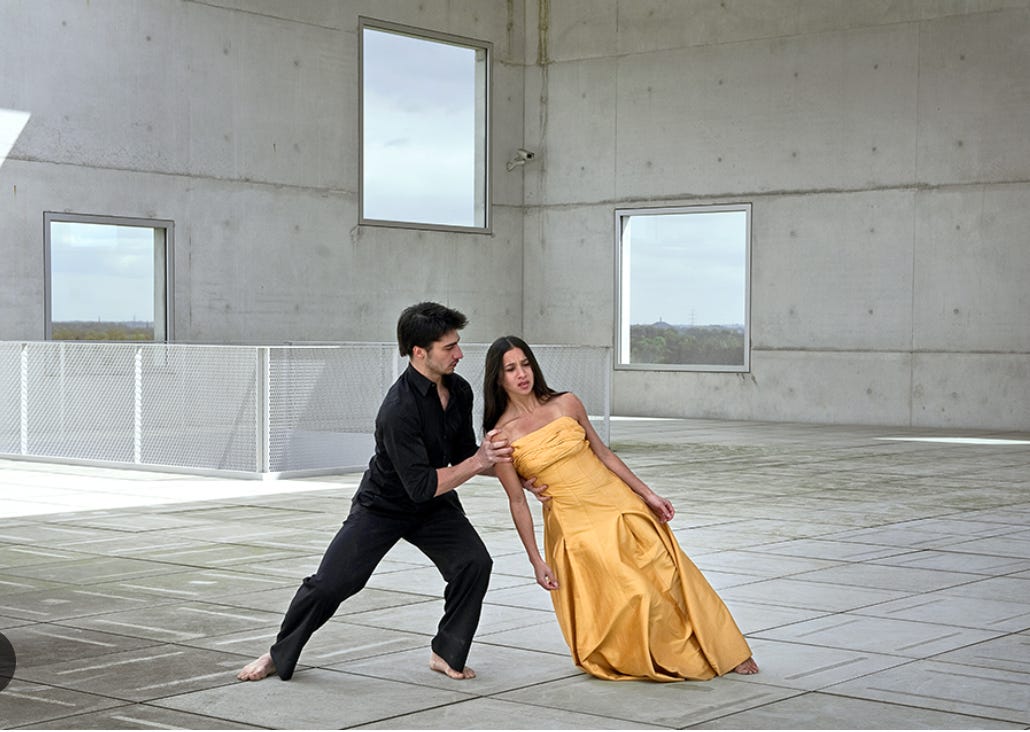
Sometimes it’s hard to remember, when deep in the writing, that characters, especially in screenplays, are people, real people. They will become these actual breathing and moving people if and when our scripts are produced thanks to the actors who embody them. So how can we write with the physicality of our characters in mind, the fact that they can move around in space and do all sorts of things with their bodies?
We’ll all be attending a dance performance by the Twyla Tharp dance company (Thanks, Hancher Auditorium!) and then will write brief scenes inspired by the performance. The focus will be to bring attention to physicality and movement into the scene. How might using your character’s body more influence their characterization as well as the drama of a scene? And where is the character in space? Are they high, low, on the same level as everyone else? How are they taking up space? Are they huge, small, dispersed and, if so, what would that look like?
What if a character…
+ cartwheels
+ did jumping jacks
+ laid down on the ground while talking
+ perched on the back of a chair like a vulture
+ stumbled
+ did sit-ups during a conversation
+ put their head down on the table during convo
+ touched another character
…and on and on.
So often, I read scenes that are mostly lines of dialogue, with little to no character action save for facial expressions. Let’s open it up to some bigger movement.
Head-to-Toe Character Writing
Over at Theatre Folk, Kerry Hishon suggests actors go head to toe when developing characters, but this is also a great exercise for screenwriters. (I’ve adapted her list of questions and suggestions below.)
+ What does the face at rest look like? Is the face expressive or masking?
+ What about eye contact? Easy and extended, or quick and uneasy?
+ What’s their smile like?
+ Does the character have good posture, or do they slouch?
+ What do they do with their arms when walking and when at rest?
+ Do they talk with their hands, or are they knotted into a ball?
+ How does the character move? Are they agile, heavy-footed, sluggish, shifty? What is their walk like? When they walk, what do they lead with (hips, forehead, chest. etc)?
+ Is the character strong or weak?
+ Does any part of their body hurt? If so, what? When?
+ Do they have any chronic illnesses? Have they been sick or injured in the past?
+ What physical quirks do they have that reveal an emotional facet?
For example, do they:
+ pick their cuticles or pull out their eyebrows (anxious)
+ pick their nose (childish and/or not observant of societal norms)
+ rock side-to-side (self comforting)
+ bounce their knee or fidget (uncomfortable or impatient)
+ spread their legs really wide when they sit down (uncouth)
But back to dance: I’m also interested in how un-ordinary physical movements might be integrated into screenwriting. Certainly a random pirouette might be used for comic effect, but what about an agonized chest pound in a moment of great emotion? What about extended, unfolding stretch in response to a question?
Dance also makes us ponder the physical relationship between characters and how this might be used to better effect. I’m not talking about movement as part of the plot. I’m talking about it as characterization and relational revelation. Some examples of the sort of physical relationship I’m talking about include:
+ One character cutting or braiding or brushing another’s hair
+ One character rubbing the feet or back or shoulder of another
+ One character carrying another, or holding another on their lap or in their arms
+ One character sitting on the floor while the other sits in a chair
Think about how character movement, touch, and/or orientation in space can enhance what we know about a character or surprise us with a new facet.